


Kolín 2
Jerusalem on the Elbe
Although the origins of the Jewish quarter in Kolín date back to the Middle Ages, the restored monuments and cultural events continue to this day to commemorate this significant chapter in history.
Explore


Weather
Thursday 19.11.
12 ° C
Friday 20.11.
8 ° C
Saturday 21.11.
8 ° C
Discover the treasures around St. Bartholomew’s Cathedral, from the ossuary and interactive exhibition to the bell tower and leafy rampart streets.
Discover a hidden gem in the heart of Kolín and get a closer look at the Gothic Cathedral of St. Bartholomew, a number of valuable art collections, and an oasis of tranquillity with a herb garden.
Beautiful Bartholemew’s Hill is testament to the fact that the historic centre of Kolín flourishes like a flowerbed in spring. It opened its doors on 20 September 2020 following extensive renovation. The town thus gained a cohesive little corner in the town centre, which offers new views of this Kolín landmark as well as a place for relaxation and contemplation.
This jewel in the crown of the entire hill is an important example of Luxembourg period Gothic architecture in Central Europe. The first construction began in the 13th century, but a hundred years later, an extensive (albeit unfinished) reconstruction took place under the direction of Petr Parléř. It was during this period that the remarkable cathedral choir was built. Further alterations were carried out during the 15th century, but the cathedral retained its medieval appearance until a devastating fire in 1796. It was not until the turn of the 19th and 20th centuries that a thorough restoration took place.
The Baroque ossuary was built in 1733 to house the remains from the former graves in the neighbouring cemetery. The incorporation of human bones into the richly ornamented interior décor in the spirit of “memento mori” makes this one of the most significant monuments of its kind in Bohemia. This medieval moral principle serves as a reminder of the inevitability of death and the transience of life.
At the beginning of the 16th century, a bell tower was built in Kolín. It was built to provide a new home for the bells that could no longer remain in the damaged towers of St. Bartholomew’s Church, but also as a proud symbol of the strength and self-confidence of the local townspeople. The building’s present appearance combines the charm of the late Gothic style with alterations made in 1872, when Josef Mocker, a leading architect of Central European Historicism, left his mark.
The “Parkány”, or rampart streets, which once protected Kolín from its enemies, now invite visitors to relax amongst the roses and herbs. The current appearance of the rampart streets combines history with a pleasant setting for relaxation. Their main feature remains the 13th-century main wall; this is one of the best-preserved sections of the town’s fortifications and today serves as a reminder of the Gothic town’s former glory.
Continue your visit with a trip to the Regional Museum, which is housed in two historically important buildings within the cathedral grounds (the Červinkov House and the Dvořák Museum of Prehistory), and also features exhibitions in the Veigertov House on Karlovo Square. This central part of the town is also graced by the former Municipal Savings Bank, designed by the architect Jan Kotěra; the town is also home to other Functionalist gems. Jews have played a part in the development of this royal town since the Middle Ages; their quarter, with its synagogue, is one of the most valuable monuments of its kind in this country. In fact, this part of town is also nicknamed Jerusalem on the Elbe.


Toilet

Cyclists
Kolín 2
Although the origins of the Jewish quarter in Kolín date back to the Middle Ages, the restored monuments and cultural events continue to this day to commemorate this significant chapter in history.
Explore

Kolín 2
Folk songs already suggest that Kolín is surrounded by flat countryside. From the Vodárna (water tower) lookout tower you can see the Gothic cathedral and the wide surroundings of this royal city.
Explore

Bike Trips
Enjoy a peaceful ride along the rivers Elbe and Cidlina from Kolín to the spa town of Poděbrady. A short relaxing trip, ending on the spa promenade, is tailor-made for calming down in hectic times.
Explore
Explore On Foot
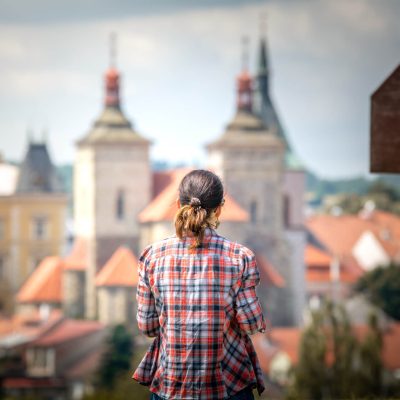
The route, suitable even for your youngest ones, takes you through ancient Slavic hillforts and a once significant royal town.
Explore

Radim
Discover the countryside estate with an interesting story, where new exhibits are continuously installed. It is open year-round.
Explore

Contributory Organization
Kouřim
The Folk Architecture Museum in Kouřim is the only multi-regionally oriented open-air ‘Skanzen’ museum in the Czech Republic.
Explore

TOP
Kutná Hora
East of Kutná Hora stands one of the few Empire buildings in the Czech Republic: the beautiful Kačina Château, surrounded by a large park. You will learn here, among other things, how the nobility farmed.
Explore